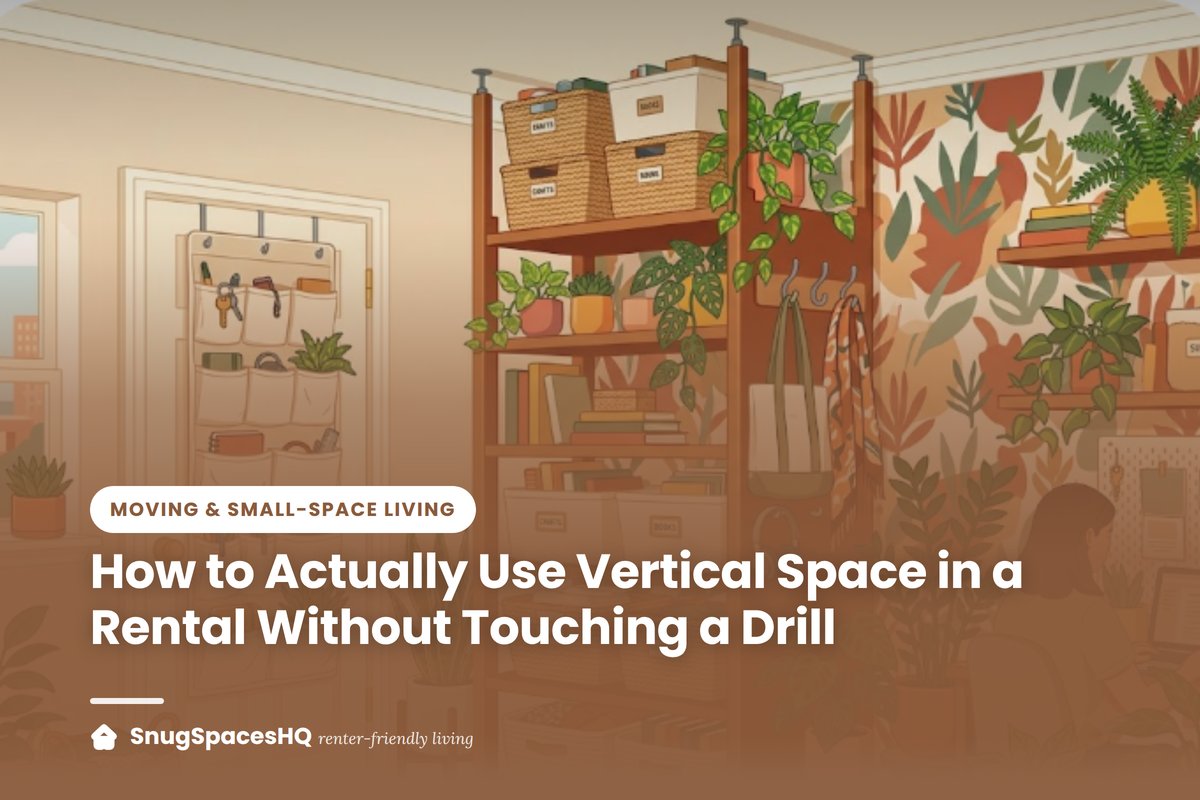
How to Actually Use Vertical Space in a Rental Without Touching a Drill
My last apartment had 8-foot ceilings and a lease that specifically called out “no holes, no exceptions, deposit forfeited” in bold text. That combination describes most renters in this country. The Fair Housing and lease-standard research floating around the rental industry keeps pointing to the same number: roughly 8 feet is still the baseline ceiling height in U.S. apartment construction, with older prewar buildings and some converted lofts running closer to 9 or 10 feet. Eight feet doesn’t give you much room to work with, but it’s not nothing, and most people waste the upper third of it entirely.
Vertical storage in a rental isn’t about buying a ladder shelf and hoping. It’s about knowing which parts of your walls, corners, and doors can hold weight without a stud finder or a drill, and being honest about which of your rooms actually need more visual height and which ones will just look like a storage unit if you add it.
Freestanding shelving beats wall shelves, full stop
If you can’t drill, a ladder shelf or etagere-style unit does almost everything a wall-mounted shelf does, minus the wall anchors and the security deposit anxiety. These lean against the wall or stand on their own four (or five) legs, and because the weight sits on the floor instead of a wall bracket, you’re not limited by drywall’s fairly low load tolerance.
IKEA’s VILTO and the smaller LUSTIGT units show up constantly in small-apartment forums for exactly this reason — cheap, freestanding, and tall enough to actually matter. A 5-tier ladder shelf against a blank wall in a studio can hold books, a small printer, plants, and bins, and it reads as furniture rather than clutter because it has a defined footprint. The trick is picking one that’s actually narrow (12 to 16 inches deep) so it doesn’t eat your walking path, and one with a stabilizing bar or wide base if you have kids or a cat that likes to climb.
Etageres work especially well in corners and next to a couch’s arm, where a flat wall shelf would look orphaned anyway. Bathrooms benefit too — a narrow freestanding shelf over the toilet tank (not attached to it, just straddling it) recovers vertical space that’s otherwise completely dead in almost every rental bathroom I’ve seen.
Over-the-door organizers, and where they’re worth it
Over-the-door organizers hang on the door itself using hooks that go over the top edge, so no hardware touches the door or frame. Most standard models fit doors between about 1 and 1.75 inches thick, which covers nearly every interior door in a U.S. apartment, including hollow-core ones.
Weight capacity varies more than people expect. Some of the flimsier mesh ones top out around 20-25 pounds distributed across all pockets, while heavier canvas or wire-shelf versions (the kind marketed for pantries) are rated up to 80 pounds total. That 80-pound number matters because it’s easy to overload a pantry organizer with canned goods without realizing it — a case of canned tomatoes alone is close to 20 pounds.
Three places these actually earn their keep in a small apartment:
- Bathroom doors, for hair tools, extra toiletries, and cleaning supplies that would otherwise live under the sink
- Pantry or kitchen closet doors, for spices, snack bags, and foil/wrap boxes
- Coat closet doors, for shoes, using the shoe-pocket style organizers instead of a shoe rack on the floor
Where they don’t work: doors that already swing into tight hallways, since the extra 3-4 inches of organizer depth can block the door from opening fully, and closet doors with bifold or sliding tracks, which usually don’t have a top edge to hook onto.
Tension rods do more than hold a shower curtain
A spring-loaded tension rod, wedged between two walls or the sides of a closet, can support a second hanging bar, a small shelf, or hanging fabric bins — no brackets. Most standard tension rods for this kind of duty are rated somewhere between 10 and 30 pounds depending on the gauge of the rod and the width it’s extended to; the wider you extend it, the less weight it safely holds, because the rod is under more leverage stress. A 3-foot closet gap is a lot more forgiving than a 5-foot one.
The realistic use case is a second, lower rod under an existing closet rod to double-hang shirts and folded pants, or a horizontal shelf tension system under the top shelf of a closet to add a second storage layer for sweaters or off-season items. Just don’t hang anything heavy and rigid off a tension rod — a canvas bin of folded t-shirts is fine, a stack of hardcover books is asking for it to come crashing down at 2 a.m. Below a kitchen sink, a tension rod mounted a few inches up creates a spot to hang spray bottles by their trigger handles, which frees up the floor of the cabinet for actual storage.
Adhesive hooks: the weight rating actually means something
Command strips and similar adhesive hooks list a rated capacity, and that number is usually conservative but not infinite. Command’s own published guide puts their small wire hooks at 1 pound, medium at 3 pounds, large at 5 pounds, and their jumbo/heavy-duty picture-hanging strips up to around 16 pounds per set when used correctly. Water-resistant and outdoor-rated versions carry similar limits to their indoor counterparts, just with different adhesive formulations for humidity and temperature swings.
Here’s the math that actually matters: the rating is per hook, and it assumes correct surface prep (clean, dry, smooth, at room temperature — not textured “orange peel” drywall, not brick, not unfinished wood) and full cure time, which for most Command adhesive is 1 hour before light use and closer to 24-72 hours before hanging the full rated weight. If you hang something the day you stick the hook up, you’re not getting the rated capacity yet, whatever the packaging implies.
To figure out what you can actually hang: add up the weight of everything going on a single hook, including the hanger, the item, and anything in its pockets. A hook rated for 5 pounds holding a canvas tote with a laptop charger, an umbrella, and a scarf can blow past that number faster than you’d think — a laptop charger and cable alone can run half a pound, an umbrella close to a pound. When in doubt, size up: two 3-pound hooks spaced a foot apart under a shelf will outperform one 5-pound hook holding the same load, because you’re splitting the shear stress.
Cube organizers and stackable bins
Cube storage units (the open-cube shelving grids, often sold in 4-, 6-, or 9-cube configurations) are freestanding by design, which makes them one of the easiest vertical wins in a no-drill apartment. Stack two 4-cube units and you’ve got a wall of storage 4 feet tall without a single anchor, and because each cube is a self-contained compartment, you can mix fabric bins, baskets, and open shelving in the same unit depending on what needs to be visible versus hidden.
The stacking part is where people get careless. Most cube units aren’t designed to be stacked more than two high without an anti-tip strap or connector kit, and stacking them unsecured next to a bed or in a room with kids is a real tip-over risk — this is the same hazard category as bookshelves and dressers that the CPSC has pushed anti-tip campaigns about for years. If you’re stacking, use the connector brackets the manufacturer sells (SONGMICS and ClosetMaid both make add-on kits for their cube lines) or run a furniture strap to a heavy, stable anchor point like a bed frame rather than the wall.
For bins specifically, buy one size family and stick to it. A shelf of mismatched bin sizes and colors looks like storage; a shelf of matched, labeled bins looks like a system. That’s a genuinely bigger visual difference than most people expect for basically no extra cost.
The space above your cabinets and closets
Kitchen cabinets that don’t reach the ceiling leave a gap most renters never touch, and it’s usually the single biggest reclaimable volume in a rental kitchen. Store things you use rarely — the roasting pan, the extra vases, the fondue set nobody’s used since 2019 — in matching baskets up there, since you’ll want a uniform look given the space is at eye level or above.
Closets are the same story, just less visible. The shelf above a closet rod usually has 12-18 inches of dead air above it before it hits the ceiling. Stackable, labeled bins here work well for off-season clothes, extra bedding, and luggage-adjacent items — the stuff you need four times a year, not four times a week. Keep the heaviest bins low and the light ones up top; a rental closet shelf is often just a single ledger board, and loading it unevenly with heavy items on one end is how shelves start to sag over a year of lease.
Tall, narrow furniture for corners
Corners are the most underused square footage in almost every small apartment, because most furniture is designed to sit flat against a wall, not tuck into an angle. A narrow bookcase, a slim bar cart, or a corner-specific etagere (some are literally cut at a 90-degree angle to nest into a corner) can add real storage volume without eating into your walking space, since corners rarely get walked through anyway.
Look for pieces under 18 inches deep for anything going in a walkway-adjacent corner, and prioritize height over footprint — a 6-foot-tall, 14-inch-wide bookcase holds nearly as much as a squat 4-foot one that’s twice as wide, but takes up half the floor.
Reading your rental’s layout before you buy anything
Not every room benefits from going vertical, and this is the part people skip. A few things to actually check before adding tall storage:
- Ceiling height relative to furniture height — in a true 8-foot room, a 6-foot shelving unit leaves only 2 feet of headroom, which can make the room feel like it’s closing in if you put more than one or two tall pieces along the same wall
- Sightlines from the entry — if a tall piece is the first thing you see walking in, it visually shrinks the room even if the storage itself is useful
- Natural light paths — a tall unit blocking a window, even partially, makes a small room read as darker and smaller, which undercuts the whole point of decluttering
- Traffic flow — measure the actual walking path width after the piece goes in; anything under about 24 inches starts to feel like a squeeze
A studio with 9-foot ceilings and one long uninterrupted wall can handle a floor-to-ceiling shelving unit as a real focal point. A choppy one-bedroom with 8-foot ceilings, three doorways, and a window on every wall usually can’t — in that layout, two or three smaller vertical pieces distributed around the room will look intentional, while one giant tower in the corner will look like you ran out of floor space and gave up. The goal isn’t to use every inch of height available. It’s to use the height that’s actually going to disappear into the room instead of dominating it.
Vertical storage solves part of it. The rest is furniture that does two jobs — see multi-functional furniture that actually works in a small apartment.