How to Move on a Budget Without Breaking Anything (or the Bank)
My last move cost $340 in truck rental, gas, and pizza for two friends. My cousin’s move three miles across town, with a “budget” moving company, ran her $1,150 and she still broke a lamp. The difference wasn’t luck. It was knowing which parts of a move are actually worth paying for and which parts are just cardboard, tape, and a Saturday afternoon.
Moving is one of those expenses that looks simple on paper and then quietly balloons. You budget for the truck and forget the boxes, the tape, the mattress bag, the tip for your buddy’s truck, the pizza, and the “oh no, this couch doesn’t fit through the door” situation that costs you an extra hour of rental. Below is what actually moves the needle on cost, based on current rental pricing and mover rates, plus the stuff nobody tells you until you’re standing in a parking lot at 9pm arguing about ramp angles.
Get boxes for free before you buy a single one
Boxes are the first budget leak most people hit, because moving supply stores mark up plain cardboard like it’s Bubble Wrap gold. A pack of ten medium boxes at a shipping store can run $30-40. You do not need to buy that.
Here’s where free boxes actually show up, and what they’re good for:
- Liquor stores — thick, reinforced boxes built to hold glass bottles without collapsing. Ask the manager which night they break down deliveries; Tuesday and Wednesday evenings are common restock days.
- Bookstores — sturdy, uniform-sized boxes that are perfect for heavy stuff like actual books, since they’re small enough not to become a back injury.
- Furniture and appliance stores — large boxes ideal for bulky, light items: pillows, comforters, winter coats, lampshades.
- Grocery stores — plentiful but flimsier, and some storage facilities won’t allow food-grade boxes in their units, so don’t rely on these if a storage unit is part of your plan.
- Facebook Marketplace and Buy Nothing groups — search “moving boxes” and you’ll usually find someone who just unpacked and wants them gone same-day, often with packing paper still inside.
- Nextdoor and local subreddits — post that you’re looking; people who just moved in are often desperate to get boxes out of their garage.
Start collecting two to three weeks out. Boxes don’t show up on demand, and you want variety in sizes, not forty identical medium boxes that leave you stacking books into a box meant for a lampshade.
What’s actually worth paying for
The instinct on a tight budget is to DIY everything, but a couple of paid line items save you money in the long run by preventing damage, injuries, or truck-rental do-overs.
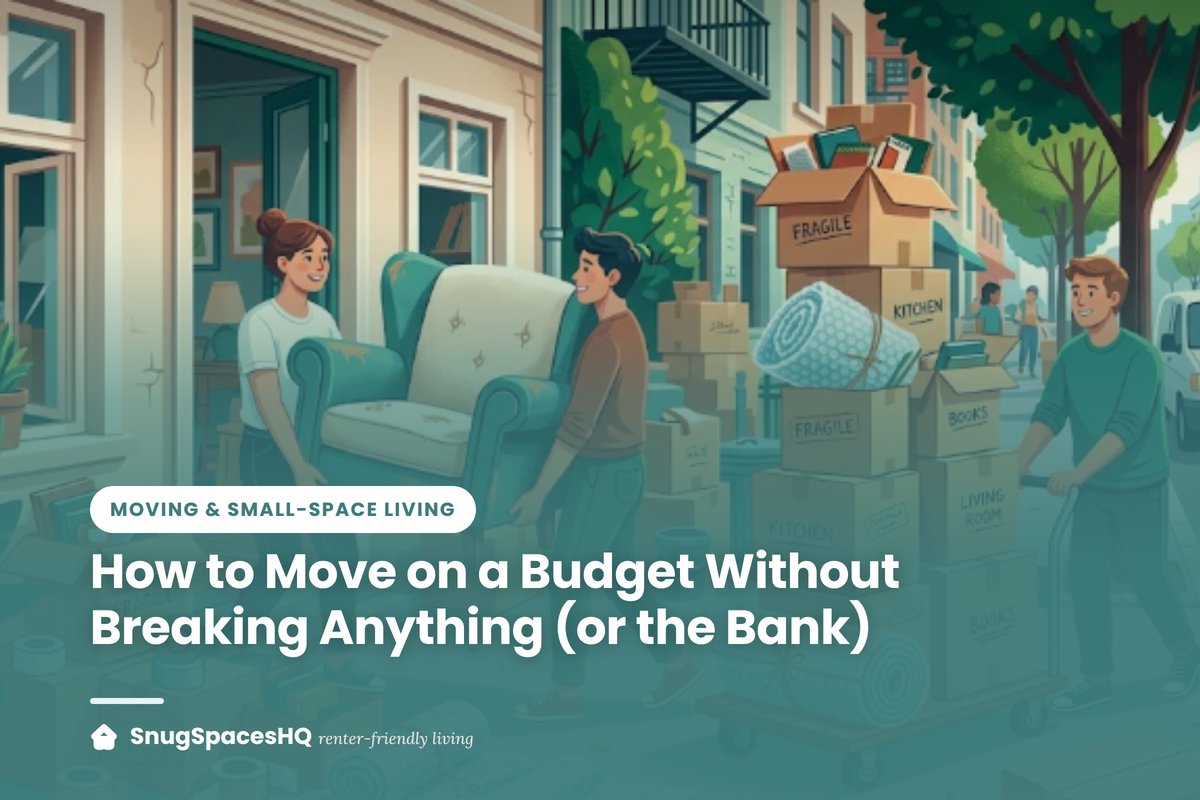
Pay for professional movers, or at minimum a moving-labor service like an app that connects you with two guys and a dolly, for anything heavy and awkward: a sofa down a stairwell, a piano, an appliance, a mattress through a tight hallway turn. These are the items that cause the two most expensive moving accidents — a wrecked back or a hole in a wall you’re on the hook for at move-out. Local movers typically run somewhere in the $120-$180/hour range for a two-person crew with a truck, more for three or four movers, and most companies have a two- to four-hour minimum whether you need it or not. If you only need help with the couch, sectional, and washer, some labor-only services will send a crew for just those items and let you handle the boxes yourself, which is often cheaper than a full-service move.
Do the rest yourself: books, clothes, kitchenware, decor, anything you can carry solo without needing three trips and a chiropractor. That’s where the real savings are, because labor is the single biggest line item in any move, not the truck.
Truck rental: what actually changes the price
If you’re driving yourself, the truck is usually your second-biggest cost after labor (or your first, if you’re doing labor yourself too). Rates vary by company, distance, truck size, and how far ahead you book, but a few patterns hold up:
- For short local moves, budget-tier rental companies tend to undercut the bigger names, sometimes by $20-40 on a one-day rental.
- For long-distance one-way moves, per-mile rates matter more than the base daily fee — a company with a low starting price can still end up pricier once mileage stacks up over a few hundred miles.
- Booking two-plus weeks ahead, especially avoiding the end-of-month rush (the 1st and 30th/31st are notoriously the busiest, priciest days to rent), can shave a meaningful chunk off the total.
- Flat-rate insurance add-ons typically range from around $15 to $30 a day depending on coverage level — skip it if your auto or renters policy already covers rental vehicles (check first), but don’t skip it if it doesn’t, because a $15 add-on is nothing next to a deductible on a truck accident.
- Weekday rentals are almost always cheaper than weekend rentals, and weekends book up fastest.
Get quotes from at least two companies for your exact size truck (a 15-footer is enough for most 1-2 bedroom apartments) and be honest about mileage. Underestimating miles is how a “$130 truck” turns into a $220 bill.
Skip the packing paper — use what’s already in your house
This is the part where you save real money and it barely feels like effort. You’re already paying to move your towels, blankets, and suitcases. Make them do double duty.
- Bath towels and bedsheets wrap dishes, lamps, and picture frames just as well as packing paper, with zero cost and no newsprint smudging your stuff.
- Suitcases and duffel bags hold heavy items like books instead of boxes — they roll, which your knees will thank you for later.
- Socks and dish towels stuffed inside glasses and mugs work better than crumpled paper because they don’t shift.
- Blankets and pillows pad the inside of the truck around furniture edges, doing the job of moving blankets you’d otherwise rent for $10-15 each.
- Laundry baskets and hampers carry loose items like bathroom supplies or pantry goods without needing a box at all.
- Trash bags (the contractor-grade kind, not the flimsy ones) work for clothes still on hangers — poke the hanger hooks through the bottom, gather the bag around, and you’ve got a garment bag for free.
None of this is glamorous, but it’s the difference between spending $60 on bubble wrap and rolls of paper and spending $0.
Protecting fragile items without buying specialty supplies
Dishes, glassware, and electronics are where people either overspend on bubble wrap or underprotect and end up gluing a mug back together. A middle path: use the towels and clothes you’re already packing as cushioning, box dishes vertically like records rather than stacked flat (they handle bumps much better standing on edge), and fill every gap in the box before closing it — a box that shifts during the drive is the actual cause of most breakage, not thin padding. For anything genuinely fragile and irreplaceable, a $10-15 roll of actual bubble wrap or a few sheets of packing paper from a dollar store is a reasonable splurge; it’s cheap insurance on something you can’t get back. For electronics, original boxes are ideal if you kept them, and if not, a snug box with a towel folded underneath and around the sides beats an oversized box with the item rattling around inside.
What a move really costs, and where it sneaks up on you
A local, in-state move for a studio or one-bedroom apartment, done mostly DIY with a rental truck, tends to land somewhere between $150 and $500 depending on distance, truck size, and gas. Bring in professional movers for even part of the job and a local move commonly runs $500 to $2,000+, with larger homes and longer carries pushing that higher. Cross-country or interstate moves are their own category entirely, often starting around $2,000-$3,000 and climbing fast based on weight and distance.
Where people actually get surprised isn’t the big-ticket stuff — it’s the accumulation of small costs nobody budgets for individually:
- Movers’ minimum-hour requirements (often two to four hours billed even if the job takes ninety minutes)
- Stair or long-carry fees when the truck can’t park close to the door
- Tape, box cutters, and a permanent marker you swear you already own but can’t find
- Tips for movers or friends helping (10-15% of the labor cost is typical for professional crews)
- Fuel for a rental truck, which gets notoriously bad mileage and needs to be returned at a specific fuel level or you’re charged a markup per gallon
- Food and drinks for whoever’s helping you, which sounds trivial until you’ve fed six people pizza twice in one day
- A cleaning deposit or move-out cleaning cost at the old place that people forget is separate from the move itself
Building a little cushion, maybe an extra $75-150, into your moving budget for exactly this kind of thing keeps a good plan from feeling like it fell apart on moving day.
Moving with roommates: splitting costs without splitting friendships
If you’re moving into a place together, the truck, gas, and any hired labor should get split evenly upfront, not sorted out afterward from memory and vibes. A shared note on your phone or a simple spreadsheet works fine, just track it as you go. Decide before moving day whether packing supplies (boxes, tape) are a shared expense or each person handles their own — shared usually makes more sense since you’re probably combining boxes into one truck run anyway.
If one roommate has significantly more stuff, or a piano, or a couch that needs three people and a dolly, it’s fair to have a conversation about that person covering a bit more of the labor cost rather than splitting everything down the middle. Nobody wants to have that conversation after the fact. Agree on it before you book anything, and put the split in writing somewhere, even if it’s just a text thread — it’s a small thing that prevents an outsized amount of post-move tension.